[syndicated profile] scalziwhatever_feed

Posted by Athena Scalzi

Hey, everyone! You may remember my post from 2024 over my friend Jon R. Mohr’s album he released that summer, Bioluminescent Soundwaves. Well, I’m happy to report that Jon has come out with a brand new song, Death is a Beautiful Cobalt Blue.

This eleven-minute composure featuring the vocals of Julie Elven is a piece that comes from deep within Mohr’s very soul, as it is the result of years of stress and existential crises. He mentions that this work is inspired by T. J. Lea’s story, “I Bought My Wife a Life Extension Plan,” which he listened to the audio drama of in January 2025.

According to Mohr, the story really spoke to him and was practically a mirror to him and his wife, who was diagnosed with POTS back in 2023.

Following the diagnosis, her job let her go, and each following job failed to accommodate her medical needs appropriately. Between the medical stress, job insecurity, financial complications, and facing the physical struggles of POTS, the couple experienced their fair share of breakdowns and emotional turmoil.

Within this story, Mohr says it entailed the most beautiful depiction of death he’d ever heard, and it brought him comfort. He decided then and there that he’d believe in this version of the afterlife, even if it made no sense, because all that mattered was that it brought him comfort, and that works for him.

Things are much better now, with Mohr’s wife having a great remote job and a better handle on her physical symptoms, plus the two of them are closer than ever. The journey through all of this made Mohr truly appreciate friends, family, and the simple things in life.

In Mohr’s own words:

Death Is a Beautiful Cobalt Blue is the result of all of that. It’s an exaltation of life, loss, beauty, and grief. It doesn’t shame or try to hide pain or the negative aspects of life. It welcomes all of it, because I feel so lucky to be able to experience all these things and truly know what makes life worth living. I also consider myself very lucky to both know what intense happiness and intense pain feel like. Because all of it is life. THIS, now, is all I can guarantee to be true and real.”

So, there you have it. A baring of a composer’s soul and struggles, as well as his joys and comforts. I hope you enjoy it, it really is quite beautiful.

Don’t forget to follow Jon on Instagram, and have a great day!

-AMS

[syndicated profile] scalziwhatever_feed

Posted by John Scalzi

Krissy and I are on our way to the JoCo Cruise, and as you can tell, we are excited! Well, I am excited, Krissy is, as ever, tolerant. Also I have brought a tiny ukulele, because, after all, is it really a vacation without a tiny ukulele?

Don’t expect too much from me over the next week. Don’t worry, Athena will be around and posting good stuff. As for me, my plan is to get on a boat and not look at the rest of the world for a while. It’s a good plan, which is why I do it annually.

— JS

eureka

2026-03-20 01:00 am
[syndicated profile] merriamwebster_feed

Merriam-Webster's Word of the Day for March 20, 2026 is:

eureka • \yoo-REE-kuh\  • adjective

As an interjection, eureka is used to express excitement when a discovery has been made. When used as an adjective, eureka describes something (typically a moment) that is characterized by a usually sudden triumphant discovery. 

// After years of trying to piece together a concrete business idea, I had a eureka moment and everything made sense.  

See the entry >

Examples:

“Back in 2020, Trautmann and fellow college student Max Steitz were lamenting the unrelenting loss of Louisiana wetlands, while sharing a bottle of wine. It was a eureka moment, as Trautmann and Steitz realized that by crushing wine bottles and other disposable glass into sand, they could relieve pressure on landfills and simultaneously help fend off coastal erosion.” — Doug MacCash, nola.com (New Orleans, Louisiana), 5 Dec. 2025 

Did you know?

When people exclaim “Eureka!” they are harking back to a legendary event in the life of the Greek mathematician and inventor Archimedes. While wrestling with the problem of how to determine the purity of gold, he had the sudden realization that the buoyancy of an object placed in water is equal in magnitude to the weight of the water the object displaces. According to one popular version of the legend, he made his discovery at a public bathhouse, whereupon he leapt out of his bath, exclaiming in Greek “Heurēka! Heurēka!” (“I have found it!”), and ran home naked through the streets. The absence of a contemporary source for this anecdote has done nothing to diminish its popularity over the centuries. The English word eureka, which of course hails from heurēka, has also retained its popularity; its use as an interjection dates to the early 17th century, and it gained a brand-new use in the early 20th century as an adjective describing moments of discovery or epiphany.


1 Peter 2:2-3

2026-03-20 12:00 pm
[syndicated profile] votd_feed
“Like newborn babies, crave pure spiritual milk, so that by it you may grow up in your salvation, now that you have tasted that the Lord is good.”

Brought to you by BibleGateway.com. Copyright (C) . All Rights Reserved.
[syndicated profile] scalziwhatever_feed

Posted by Athena Scalzi

Like two peas in a time travel pod, archivist and author Katy Rawdon teamed up with Hugo-award winning editor Lynne M. Thomas to craft the perfect time travel narrative. Take a closer look at famous time travel stories from all across the globe in The Infinite Loop: Archives and Time Travel in the Popular Imagination, with a foreword from one such writer herself, Connie Willis.

KATY RAWDON (a.k.a. KATY JAMES):

Archives are made of time. Time is made of archives. Archives are where time gets mixed up, turned around, and pulled apart.

I have always been obsessed with time, frustrated with it, wanting to tear at it and see what’s behind and underneath it. No doubt that’s why I became an archivist some thirty years ago, so that I could look at the physical remnants of time and preserve them, see what’s missing, and organize and interpret time’s leftovers for people who, wisely, do not think about time all the… time.

When I was approached to submit an idea (a big idea!) for a book series jointly published by the American Library Association (ALA) and the Society of American Archivists (SAA) called Archival Futures – a series that tackles big ideas around the archival profession – there was only one possible topic for me to write about: time.

While the phrase “archives are like time travel” is thrown around a lot, I knew the relationship between historical records and time was far more complicated. Archives reinforce and challenge our very conceptions of time, of what has happened, of what will happen, of what is truth and what is unknowable. The evidence of archives can be used to demonstrate how the past is so much more faceted than the narrow stories of history we tend to tell ourselves and others. Archives can also be selectively wielded as propaganda, or erased to allow for falsehoods to sprout and flourish in the empty spaces. Time can be illustrated, illuminated, rendered invisible, or constructed in new ways using the material items created in the course of history. 

Unfortunately, all of this turned out to be so complicated that the series’ word limit of 50,000 was never going to cover it, as I painfully discovered while writing the book proposal.

I am forever grateful that the inimitable Lynne M. Thomas stepped into my creative mess and provided direction: Why not analyze the depiction of both archives and time travel in popular narratives (books, television, movies, etc.) and see what we could unearth? As a romance author (Katy James) as well as an archivist (Katy Rawdon), I was more than happy to spend time in fictional worlds in order to better understand my non-fictional archivist profession.

It turns out that we unearthed a lot – about cultural views regarding time and time travel, the popular perception of archives and archivists, and the ways current archival theory and practice intersect (or don’t) with ideas about time and time travel. 

How does time work? How is it understood by different people and cultures? How do archives help or hinder our understanding of the past (and future)? How can popular narratives about time travel and archives guide archivists to shift their methods to a more expansive, inclusive, transparent approach? How can archival workers apply current archival theory and practice to all of the above ideas to better serve their communities and increase the use of archives?

Researching this book and synthesizing all of the swirling concepts was a real mind-twister of an exercise, trying to write our expansive, big ideas while keeping it succinct and legible for archivists and general readers alike.

We hope we’ve succeeded.

LYNNE M. THOMAS:

Sometimes, if you’re very lucky, the right project turns up at exactly the right time. As a professional rare book librarian, twelve-time Hugo Award winning SFF editor and podcaster, and massive Doctor Who fan, I had a moment of “I was literally made for this” when Katy explained her concept for the book to me and asked me to join her. My initial contribution was more or less “but what if we add Doctor Who examples to make all this time stuff understandable,” and then … we got excited. Because when you have the chance to dive deep into a particular rabbit hole that looks perfect for you specifically, you lean hard into your personal weird. 

Time travel stories often feature archives to prove the narrative truth of characters’ experiences. The main character goes into a locked room full of dusty boxes, and immediately finds the one piece of documentary evidence they need to solve their problem, or make sense of their experiences. And yet archivists—the people tasked with organizing and running archives—are almost always invisible or nonexistent in these very same narratives. When we do show up…well, it feels like writers haven’t talked to an archivist lately.

That…bothered us. It turns out, when you have professional archivists and librarians who are also active writers and editors in science fiction, we have thoughts and opinions about how archivists and librarians are portrayed (or not) in fiction and nonfiction. But we thought, maybe we’re seeing a pattern that doesn’t exist, it’s just that “red car syndrome” thing where experts pay more attention to the areas of their expertise in the narratives than non-experts do. So… we checked. We looked at dozens of time travel stories across novels, comics, television series, and films. We discuss Doctor Who, of course, but also Loki, Star Wars, works by Connie Willis (who wrote our foreword), Octavia Butler, Jodi Taylor, Rivers Solomon, Deborah Harkness, and H.G. Wells, among many, many more. We also looked at a whole lot of archival literature—how archivists and librarians talk about themselves, their professions, and their work to one another. And because we are both academic librarians, we laid out our findings in a peer-reviewed book. 

What we learned is that there’s a massive divide between what pop culture thinks we do, and what we actually do, and the even greater divide between the level of resources pop culture thinks we have, and what we actually have…and we posit multiple ways to close those gaps.

The Infinite Loop is where archives and pop culture’s image of archives meet and have a long overdue chat. Our hope is that these conversations will lead to archivists being better able to explain what we do, and have that knowledge spread far and wide across popular culture. Ideally, with some time travel stories that feature archivists as main characters. It’s well past time.


The Infinite Loop: Amazon|Barnes & Noble|Powell’s|Inkwood Books

Author socials: Katy’s Bluesky|Katy’s Instagram|Katy’s Website|Lynne’s Bluesky|Lynne’s Instagram|Lynne’s Website

[syndicated profile] scalziwhatever_feed

Posted by John Scalzi

The legal firm that is apparently handling at least some of the Anthropic Copyright Settlement case has started sending out notifications of some sort to presumably affected parties. Small problem: Some of these were sent not to the addresses of the presumably affected parties, but to mine.

I have not opened these notifications, as they are not addressed to me, so I don’t know what’s in them or what they say, and I will be henceforth disposing of these notifications unopened. However, if you are Jody Lynn Nye, Sarah Hoyt, Eric S. Brown, Christopher Smith, or the estate of Eric Flint, please be aware that JND Legal Administration is trying to inform you of something (probably that you have works that are eligible to be part of the class action suit).

I have contacted the firm in question and told them about these incorrect addresses and, for the avoidance of doubt, also informed them at no other affected author than me lives at my address. Hopefully that will take. That said, I would not be surprised if I get more notifications, not for me. What a wonderful age of information we live in.

— JS

nadir

2026-03-19 01:00 am
[syndicated profile] merriamwebster_feed

Merriam-Webster's Word of the Day for March 19, 2026 is:

nadir • \NAY-deer\  • noun

Nadir refers to the lowest or worst point of something. When used in astronomy, nadir describes the point of the celestial sphere that is directly opposite the zenith and vertically downward from the observer.

// Only once the novel’s protagonist reaches her nadir does she arouse the reader’s empathy, and we root for her to climb back to respectability.

See the entry >

Examples:

Sacrament dives right into the nadir of the 2020 health crisis, following a group of nurses who have moved into makeshift housing near a California hospital, to isolate from their families during the height of the case surge.” — James Folta, LitHub.com, 1 July 2025

Did you know?

Nadir is part of the galaxy of scientific words that have come to us from Arabic, a language that has made important contributions to the English lexicon especially in the fields of mathematics, astronomy, medicine, and chemistry. The source of nadir is naḍhīr, meaning “opposite”—the opposite, that is, of the zenith, the highest point of the celestial sphere which is positioned vertically above the observer. (The word zenith itself is a modification of another Arabic word that means “the way over one’s head.”) Though born of the heavens, both words are called upon to refer to earthy things too, especially a significant point or period of time, be it a high point or low one.


Galatians 5:22-23

2026-03-19 12:00 pm
[syndicated profile] votd_feed
“But the fruit of the Spirit is love, joy, peace, forbearance, kindness, goodness, faithfulness, gentleness and self-control. Against such things there is no law.”

Brought to you by BibleGateway.com. Copyright (C) . All Rights Reserved.
[syndicated profile] excuseoftheday_feed
tsunamis in the wave-division multiplexer

jejune

2026-03-18 01:00 am
[syndicated profile] merriamwebster_feed

Merriam-Webster's Word of the Day for March 18, 2026 is:

jejune • \jih-JOON\  • adjective

Jejune is a formal word that means "uninteresting" or "boring." It is also used as a synonym of juvenile to describe things (such as behaviors, attitudes, etc.) that are immature, childish, or simplistic.

// The movie adaptation employed surreal visual effects to tell the story, making the plot, jejune in the novel, archetypal rather than artless.

// The professor made rude and jejune remarks about the students' artwork.

See the entry >

Examples:

"While [author Helen] Garner has journaled most of her life, she burned her early diaries in a bonfire having deemed them too embarrassing or jejune." — The Irish Times, 29 Mar. 2025

Did you know?

Starved for excitement? You won't get it from something jejune. The term comes to us from the Latin word jejunus, which means "empty of food," "hungry," or "meager." When English speakers first used jejune back in the 1600s, they applied it in ways that mirrored the meaning of its Latin parent, lamenting "jejune appetites" and "jejune morsels." Something that is meager rarely satisfies, and before long jejune was being used not only for meager meals or hunger, but also for things lacking in intellectual or emotional substance. It's possible that the word gained its now-popular "juvenile" or "childish" sense when people confused it with the look-alike French word jeune, which means "young."


Romans 15:13

2026-03-18 12:00 pm
[syndicated profile] votd_feed
“May the God of hope fill you with all joy and peace as you trust in him, so that you may overflow with hope by the power of the Holy Spirit.”

Brought to you by BibleGateway.com. Copyright (C) . All Rights Reserved.

Chapter 2, Page 4: Cosmetic

2026-03-18 12:00 am
[syndicated profile] knell_webcomic_feed

Posted by SarahN

Necromancy: Useful for this sort of work.

Sorry for the delays. I just needed a bit of a break simply due to burnout and wrist pain issues.

________

Patreon is ahead in pages for both Knell and The Devil’s Trill!
You can see the early pages for $1, WIP shots for $2, and HD pages for $5.
And please, if you sign up to become a patron, do it through a browser and NOT the Patreon app!! Apple is once again ripping off artists by taking a huge percentage from creators if you use the Patreon app!

Read this comic at other sites!-

Knell at Tapas!

Knell at ComicFury!


CHECK OUT MY OTHER WEBCOMICS!

↓ Transcript
We see multiple shots of the corpse's wounds being closed up by stretching out what remaining flesh there is over them, via Devere's green necromantic magic. The wounds being closed are gaping bite wounds on his side and arm, and one of his legs, which is missing the entire lower half starting above the knee, is closed into a simple stump. The end result would be presumably be imperfect. Gates answers Devere's concerns as he works.
Gates: We just gotta clean 'im up as best we can. Then I'll use some powder and sprays before we cover 'im back up.

Devere stares at the corpse with glowing eyes and continues to gesture with his hands to finish up his magical work. Gates simply observes.
Gates: At least his head ain't too bad. Besides the rot, I mean. You can close them scratches on his face easily, right?
Devere: He'll still look scarred.

A closeup of the withered corpse's face, which appears to be a young man with longer brown hair. His eyes are closed but his mouth hangs open a little. There are very large cuts all the way down his face from knucker claws. Gates comments off screen.
Gates: Just do what ya can.

The shot of the man blurs and we fade out to the next scene.

The Big Idea: J. M. Sidorova

2026-03-17 07:20 pm
[syndicated profile] scalziwhatever_feed

Posted by Athena Scalzi

How is it that fairy tales persist? In the Big Idea for The Witch of Prague, author J.M. Sidorova suggests that it might be because they are malleable and can be made to fit more times and places than just their own. To what use has the author put them here? Read on.

J. M. SIDOROVA:

When I think about a Big Idea of a novel, what comes to my mind first is more of a premise, an inceptive sprout from which the novel had grown. In this regard, The Witch of Prague grew out of a common fairy-tale archetype: an old hag gives a magic gift/poison apple to a young girl; think Sleeping beauty, forests, and castles. Except in this case, the archetype was invoked by true stories my Mom had told me about her young adulthood.

Thus, forests became the Cold War era Eastern European bureaucracies, castles became government departments, and the relationship between the hag and the young girl became complicated, as I, in the act of reimagining the fairy tale, subverted the heck out of it.

That said, this novel took a long time to become what it is now; it evolved in fits and starts while a sizeable chunk of my life was going by and the world was changing, and as a result it became a repository of symbolic representations for the ideas that are not new but have been important for me to unpack and highlight.

There is the Hunt of a Unicorn that, historically, fronts a host of contradictory ideas about power asymmetries between women and men; and then there is a Stag Hunt, which, as an example of a game of trust (or, more broadly, public goods game theory, like it’s better known cousin, the prisoner’s dilemma), stands for a balance of trust/cooperation vs. predation/competition in a given society.

There is also the Orwellian idea that authoritarian regimes not just restrict speech and writing, but, far more insidiously, they warp the very meaning, usage, and purpose of words, of the language itself. My main character, Alica, who’s grown up with mild dyslexia, is primed against such shenanigans because she’s always thought words were treacherous and out to get her, and one of her ways of fighting back was to invent an imaginary friend, a live typewriter with spider legs and word-swatting pincers.

So many different symbols, in other words, that at some point even I, their compulsive collector, felt that it was too much. And my awesome editors, Rachel Sobel and Huw Evans of Homeward Books, were of the same opinion: wait, is the Stag the same as the Unicorn or not? Author, explain thyself! So I went on an editing rampage, and I think I fixed things, and now all symbols are there to serve the story. 

But the big — or at any rate the permeating — idea that I would like to foreground since we are talking speculative fiction here, is what constitutes magic in this book. I think if one creates an alternative, fully magic-enabled reality for one’s tales, one can give a reader an escape, a full-on suspension of disbelief and all that, and that is fine. But if one instead injects bits of fantastical or magical into our viscerally recognizable reality, one gives a yearning, gives flickering moments of disassociation, of belief, “what if it were real?” It’s like magic comes to you, instead of you taking a vacation to go see magic.

And of course, so many works of speculative fiction do one approach or the other or anything in between. I personally, prefer the latter end of the spectrum over the former. So, what I was trying to do in The Witch of Prague was to have seemingly small, tenuous even amounts of magic within a historically accurate reality, and I was interested to work with this premise: what if magic was generated from scratch under certain unique constellations of circumstances and human lived experiences and emotional states, for instance, extreme trauma or enduring hope or devotion?

It wouldn’t be by anyone’s design, and it would be hard to predict what or who would become the magic’s “carrier” once it was produced. It would be a sort of undomesticated, involuntary magic for which no one really knows the rules or capabilities, though one could make assumptions or jump to conclusions according to one’s beliefs or character, in trying to harness it to one’s own benefit.

If we agree that as humanity, we have always been “producing” magic in our stories, histories, and self-narratives (“it was a miracle that I survived!”) as a matter of belief or metaphor, to help us parse reality or even just to communicate it — then my premise in this novel simply takes this fact and implements it. Literally and physically.


The Witch of Prague: Asterism|Homeward Books

Author socials: Website|Blog

[syndicated profile] lets_encrypt_feed

Nick Silverman is a Senior Infrastructure Engineer on the Edge Infrastructure team at Shopify, where he maintains the systems that provision, renew, and publish SSL certificates for millions of merchants’ custom domains. He is also a contributor to the Ruby acme-client gem.

The challenge

Shopify’s automated certificate management system relied on a static renewal threshold: 30 days before the end of the 90-day lifetime. To spread the load of provisioning and renewing certificates, we implemented a random 0–72 hour delay for each. While this helps evenly distribute certificate management over time, it did not take into account the Certificate Authority’s (CA) load. It was also incapable of reacting to a dynamic renewal window based on information provided by the CA.

However, this approach needed greater resilience to solve what is, in the end, a distributed coordination problem. The weaknesses are:

  • No rapid revocation response: The static logic is not aware of revocations at all.

  • Brittleness to lifetime changes: The static 30-day threshold is not resilient to changes in certificate lifetime, such as Let’s Encrypt’s announced plan to move to 45-day certificates.

  • Imperfect load distribution: Despite the random jitter, massive renewal bursts could still occur.

Shopify needed to develop a global coordination system to balance the load and handle regular and urgent renewals. Thankfully, Let’s Encrypt has led the charge on a solution for this and other very important aspects of the certificate lifecycle.

The journey

Let’s Encrypt and the Internet Engineering Task Force (IETF) published the ACME Renewal Information (ARI) standard which makes an endpoint available that provides a recommended window of time for the renewal to occur. The endpoint returns a payload that looks something like this:

GET /renewal-info/ACME_KEY_IDENTIFIER
{
  "suggestedWindow": {
    "start": "2026-02-03T04:00:00Z",
    "end": "2026-02-04T04:00:00Z"
  }
}

Shopify’s certificate management system uses the acme-client Ruby gem originally authored by another Shopify employee. A growing number of ACME clients, including certbot, have enabled support for ARI, but the Ruby gem did not yet support this feature. Rather than building a custom solution, we decided to enable support for the ARI extension directly in the client.

Let’s Encrypt’s guide to integrating ARI provided the necessary roadmap, and the implementation was completed with one PR. This contribution means that not only Shopify, but also the wider Ruby community, can benefit from the ARI extension.

Deployment and ARI at scale

Once we shipped the gem support, integrating ARI into our certificate management system was straightforward. Instead of checking a static 30-day threshold, we now query the ARI endpoint and use the suggested renewal window as the gate for initiating renewals. Those dates are stored alongside the certificate upon its initial provisioning.

The updated Ruby gem provides a method for fetching renewal information:

renewal_info = client.renewal_info(certificate: existing_certificate_pem)

This method generates an ARI certificate identifier that can be used when making the API call. The client also includes a helper method, suggested_renewal_time, which chooses a random time between the returned start and end dates. The certificate identifier can be passed to the new_order method via the replaces key, which can grant a higher priority or bypass rate limits for renewals occurring during the window, depending on the CA’s policies.

Critically, Shopify also regularly polls the ARI endpoint for updated renewal timestamps. This allows our systems to rely on those timestamps as the primary renewal timing logic and removes the need for inflexible hard-coded expiry thresholds. This becomes the mechanism that LetsEncrypt uses to dynamically change the renewal time due to a revocation event.

Results and rewards

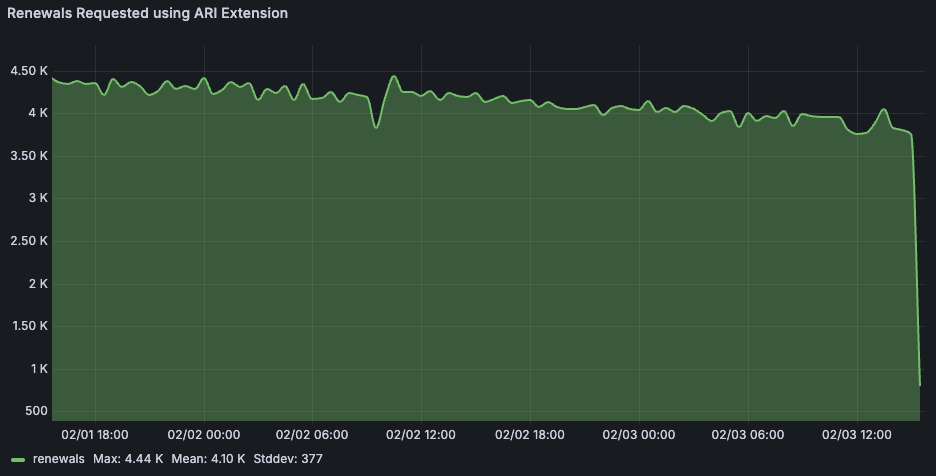
Since enabling the use of the ARI extension, our certificate management system has become significantly more robust. Shopify now delegates the responsibility of determining renewal timing to Let’s Encrypt. The ARI extension has proven to be an impactful infrastructure improvement and the benefits gained are immediate. These benefits, alongside fewer manual interventions, are the operational success story:

  • Future-proofing: We gained resilience against any future certificate lifetime changes and mass revocation events without needing code updates—ensuring our renewal logic is flexible.

  • Optimized load: We directly benefit from the CA’s coordinated load balancing provided by the suggested renewal window, eliminating local randomness issues and the need for complex global coordination.

  • Revocation readiness: ARI allows systems to quickly detect and respond to revocation events when an urgent renewal is necessary, well before certificates get close to their due dates.

  • Simple implementation: The extension is mature (RFC 9773) and the implementation is straightforward, providing simplified renewal logic and CA-optimized timing.

  • Good citizenship: Anyone using ARI helps the CA optimize its infrastructure, and contributes to better aggregate behavior across the entire ecosystem.

If you’re still relying on static renewal thresholds, give ARI a look—Shopify wholeheartedly encourages all ACME users and client developers to adopt the ARI extension.

Erin go bragh

2026-03-17 01:00 am
[syndicated profile] merriamwebster_feed

Merriam-Webster's Word of the Day for March 17, 2026 is:

Erin go bragh • \air-un-guh-BRAW\  • phrase

Erin go bragh is an Irish phrase that means “Ireland forever.”

// They proudly waved the Irish flag during the parade, shouting “Erin go bragh!”

See the entry >

Examples:

“Dressed in full Irish regalia, Fitzgerald rode his horse, Jack, through the streets of Clinton every St. Patrick’s Day. Jack was also dressed for the occasion, with green ribbons on his mane and a green blanket with gold lettering, ‘Erin Go Bragh.’” — Craig S. Semon, The Worcester (Massachusetts) Telegram & Gazette, 22 Dec. 2025

Did you know?

March 17th is the feast day of the patron saint of Ireland, St. Patrick. In the United States, it is also the day of shamrocks, leprechauns, and green beer (and green everything else). Blue was once the color traditionally associated with St. Patrick, but the color green has several links to Ireland, including its use on Ireland’s flag in the form of a stripe, its symbolism of Irish nationalism and the country’s religious history, and its connection to Ireland’s nickname, The Emerald Isle. On St. Patrick’s Day, people turn to their dictionary to look up Erin go bragh, which means “Ireland forever.” The original Irish phrase was Erin go brách (or go bráth), which translates literally as “Ireland till doomsday.” It’s an expression of loyalty and devotion that first appeared in English during the late 18th-century Irish rebellion against the British.


Psalm 23:1-3

2026-03-17 12:00 pm
[syndicated profile] votd_feed
“A psalm of David. The LORD is my shepherd, I lack nothing. He makes me lie down in green pastures, he leads me beside quiet waters, he refreshes my soul. He guides me along the right paths for his name’s sake.”

Brought to you by BibleGateway.com. Copyright (C) . All Rights Reserved.

Style Credit

December 1 2 3 4 5 6 7 8 9 10 11 12 13 14 15 16 17 18 19 20 21 22 23 24 25 26 27 28 29 30 31 2023

Expand Cut Tags

No cut tags
Powered by Dreamwidth Studios
Page generated 2026-03-20 10:19 pm